Ancient Egypt: Myth of Osiris
Timeline
- First Hominins Period: The earliest, dating 7-6 million years ago.
- Early Hominins Period: From 2.7 - 1.5 million years ago.
- Paleolithic Period: Roughly from 2.5 million years ago to 10,000 B.C.
- Neolithic Period: From around 4300 BC down to 2000 BC
Indigenous Caribbean 1492 AD (Spider web idea)
Syncretic Caribbean 2022 AD (Spider web idea)
- Copper or Chalcolithic Age: 3500 to 2300 BCE.
- Bronze Age: 3300 BC to 1200 BC,
- Iron Age: 1200 B.C. and 600 B.C.
- The Portuguese, in the 16th century, were the first to buy slaves from West African slavers and transport them across the Atlantic. In 1526, they completed the first transatlantic slave voyage to Brazil, and other Europeans soon followed.
- Syncretic Caribbean: 2022 AD (Spider Web idea)
- Ancient Egypt: First Dynasty: 3150 - 2890 B.C. / Apis Bull Ritual or The Running of Apis
Radjedef) (also known as Djedefra and Djedre) was an ancient Egyptian king (pharaoh) of the 4th Dynasty during the Old Kingdom. He is well known by the Hellenized form of his name Rhatoisēs (Ῥατοίσης) by Manetho. Djedefre was the son and immediate throne successor of Khufu, the builder of the Great Pyramid of Giza; his mother is not known for certain. He is the king who introduced the royal title Sa-Rê (meaning “Son of Ra”) and the first to connect his cartouche name with the sun god Ra.
Middle Kingdom, / 2,050-1,800 B.C. / The first known priestess of Hathor was Neferhtepes, (pharaoh of the mid Thirteenth Dynasty ruling in the second half of the 18th century BC during the late Middle Kindom) daughter of King Radjedef in the Old Kingdom.
New Kingdom / until about 343 B.C.
Greek rule: The Isis-Moon connection first started when Egypt came under Greek rule
in the 3rd century BCE, following the conquest by Alexander the Great.
I
Unit: Ancient Egypt
Theme: Myth of Osiris
Introduction
- Understand the importance of a myth
- Explain the role of Isis in the Myth of Osiris
- Gain an awareness of the representation of different characters in the myths
- Experience the representation of the Myth of Osiris
III
Main Lesson
1
Isis Osiris and the Rites of Spring
2
Myth of Osiris
|
|
 |


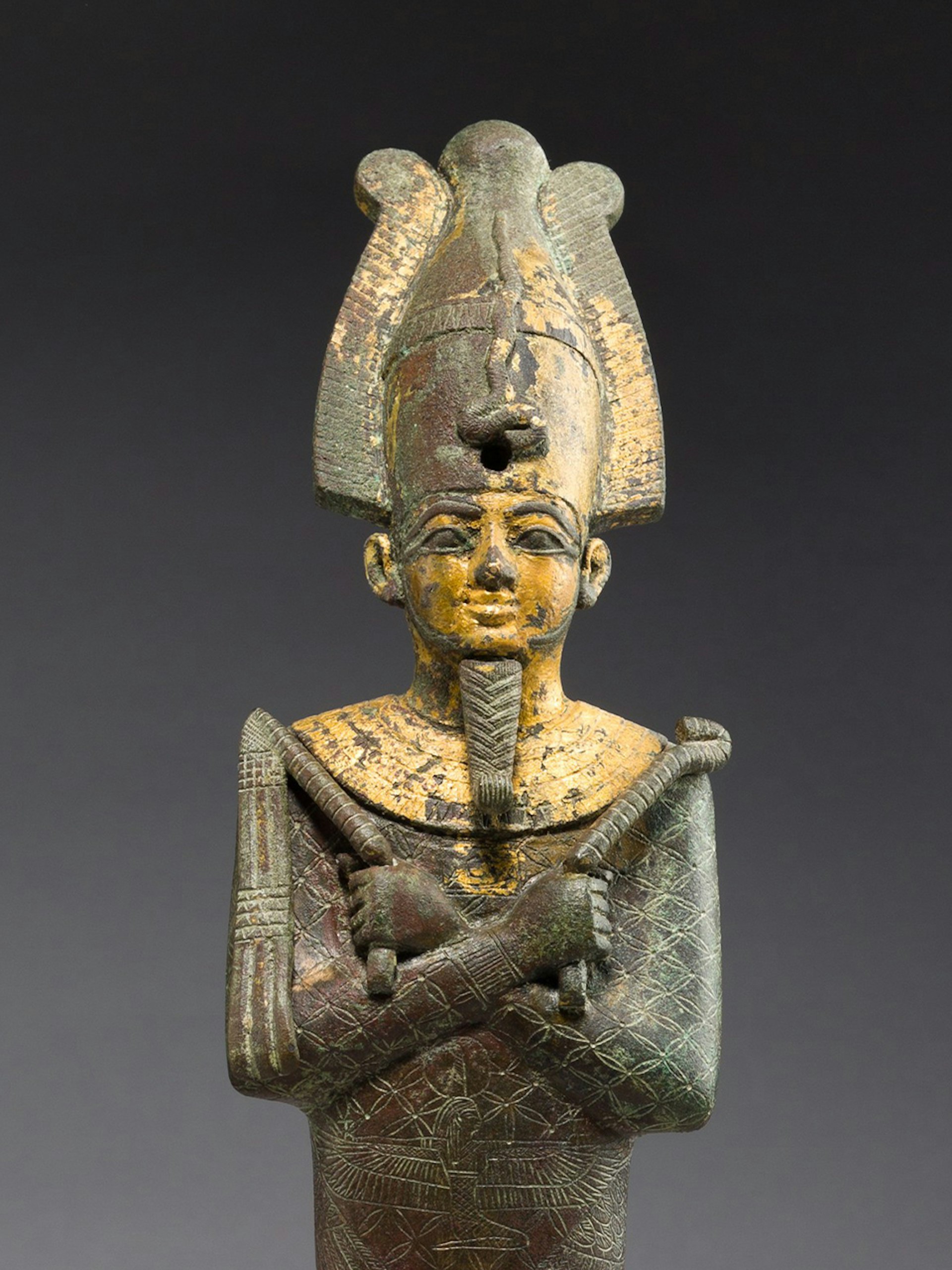
The myth of Osiris is the most elaborate and influential story in Ancient Egyptian mythology. It refers to the murder of the God Osiris, a primeval king of Egypt, and its consequences.
1) At the start of the story, Osiris rules Egypt, having inherited the kingship from his ancestors in a lineage stretching back to the creator of the world, Ra.
2) Osiris's murderer, his brother Set, usurps his throne out of revenge towards Osiris who had slept with his wife Nephthys.
3) Osiris's death is followed by a period in which Set assumes the kingship
4) while Isis (becoming a bird) searches for her husband's body with the aid of Nephthys and other deities, including Thoth, a deity credited with great magical and healing powers, and Anubis, the god of embalming ane funeral rites.
5) Set or his followers try to damage the corpse, and Isis and her allies must protect it.
6) Once Osiris is made whole (becoming the first mummy), Isis, still in bird form, fans breath and life into Osiris's body with her wings and copulates with him.
7) Isis conceives Osiris son and rightful heir, Horus.
8) The remainder of the story focuses on Horus, the product of the union of Isis and Osiris, who is at first a vulnerable child protected by his mother and then becomes Set's rival for the throne.
Their often violent conflict ends with Horus's triumph, which restores Maat (cosmic and social order) to Egypt after Set's unrighteous reign and completes the process of Osiris's resurrection. Although he lives on only in the Duat, he and the kingship he stands for will, in a sense, be reborn in his son.
Activity
Students create a tableau using the above numbered parts of the Myth of Osiris.
3
According to Campbell (2010, 1:00 - 1:21) myth lets one know where one is at. Myth knows what the patterns of life have been through centuries in that position one is now entering or holding. That is the power of myth for human kind.
Question 1
Why is the study of myth important?
Thus, the myth of Osiris was deeply influential in ancient Egyptian people because of its primary religious meaning, which implied that any dead person can reach a pleasant afterlife.
Another reason is that the characters and their emotions are more reminiscent of the lives of real people than those in most Egyptian myths, making the story more appealing to the general populace.
In particular, the myth conveys a "strong sense of family loyalty and devotion which is illustrated by the relationships between Osiris, Isis, and Horus.
Question 2
What would be an equivalent American myth that has kept the country together since its creation?
4
Intersection

Goddess
Isis with the Horus Child - Bronze - very rare with a Vulture Head -
Ancient Egypt, Late Period - Ptolemaic Period, 664 - 32 BC Material:
Solid Bronze. Size: 19,2 cm H. without stand. Provenance: Old Parisian
collection. Acquired in the T. M. auction house, Paris, 2016.
Isis and Hathor: Intersecting Mythologies
Sometimes Isis and Hathor are considered
to be the same Egyptian female deity. That's because the worshipers of
Isis borrowed, assimilated, and adapted Hathor's attributes to the
extent it is often difficult to distinguish the two goddesses from one
another. While both embodied motherhood and family ties, the two
goddesses are not the same. Hathor is the more feminine deity of
pleasure, dance and the arts, while the mythology of Isis is focused on
love, loyalty, death, resurrection, and transformation.
Thus, Isis became one of the most important goddesses of ancient Egypt. She was a great magician, whose power transcended that of all other deities. In the first millennium BCE, Osiris and Isis became the most widely worshiped Egyptian deities, and Isis absorbed traits from many other goddesses. Rulers in Egypt and its neighbor to the south, Nubia, built temples dedicated primarily to Isis, and her temple at Philae was a religious center for Egyptians and Nubians alike.

5
For the ancient Egyptians, the goddess Isis was the model of the loyal wife and mother, as well as a powerful magician. She was the wife of the god Osiris and the mother of Horus. Just as the king of Egypt was associated with Horus in life and Osiris in death, queens of Egypt were linked with Isis, and their visual representations have similarities with the goddess. For example, both may be depicted wearing the vulture headdress shown above. The crown composed of a sun-disk and cow horns originally belonged to Hathor, but was assimilated by Isis.
Question 3
Why was Isis an important character in the Myth of Osiris?
9

Isis' reputed magical power was greater than that of all other gods, and she was said to protect the kingdom from its enemies, govern the skies and the natural world, and have power over fate itself. Perhaps inspired by the picture above, the producers of the video bellow created the dance concept produced by G. Davenport.
IV
A Note to Remember
The power of a myth for humans is that it lets them know what the patterns of life have been throughout the centuries and their role within them.
V
Case Study
1
Isis also inspired the dance believes that moved Ruth St. Denis to generate a whole new philosophy about the role of dance in the betterment of mankind.
Ruth St. Denis
Question 4
According to this interview, what was St. Denis' intuitive idea about the Gods and dance?
In Egypt the peacock was linked to the worship of the sun god, Ra and associated with the all-seeing eye of Horus. Of all the birds, the peacock most resembles the traditional description of the phoenix. The phoenix is the legendary bird of resurrection that is sacrificed in the fires of life and then rises from the flames out of its own ashes. As a reflection of the phoenix, the peacock was often associated with immortality and re-birth, and considered sacred by many cultures and religions. The Egyptians associated the phoenix with immortality, and that symbolism had a widespread appeal in late antiquity.
Source: https://academyofancientreflexology.com/resources/peacocks/history-and-myth/
Question 5
After reading the text taken from the Academy of Reflexology, with which deity would you guess the bird of resurrection (the phoenix or the peacock) was associated with in Egyptian mythology?
2
Dance of the Peacock
Dancer: Livia Vanaver for The Vanaver Caravan Dance Co.
All Ruth St. Denis dances were recreated by Jane Sherman with generous funding from the NYSCA Dance Program. Jane Sherman, (1908 – 2010).
Question 6
.jpg)


Link:
https://www.archaeology.org/issues/445-2111/features/10053-egypt-philae-temples

Comments
Post a Comment