Ancient Egypt: Myth of Hathor
Timeline
- First Hominins Period: The earliest, dating 7-6 million years ago.
- Early Hominins Period: From 2.7 - 1.5 million years ago.
- Paleolithic Period: Roughly from 2.5 million years ago to 10,000 B.C.
- Neolithic Period: From around 4300 BC down to 2000 BC
Indigenous Caribbean 1492 AD (Spider web idea)
Syncretic Caribbean 2022 AD (Spider web idea)
- Copper or Chalcolithic Age: 3500 to 2300 BCE.
- Bronze Age: 3300 BC to 1200 BC,
- Iron Age: 1200 B.C. and 600 B.C.
- The Portuguese, in the 16th century, were the first to buy slaves from West African slavers and transport them across the Atlantic. In 1526, they completed the first transatlantic slave voyage to Brazil, and other Europeans soon followed.
- Syncretic Caribbean: 2022 AD (Spider Web idea)
- Ancient Egypt: First Dynasty: 3150 - 2890 B.C. / Apis Bull Ritual or The Running of Apis
Radjedef) (also known as Djedefra and Djedre) was an ancient Egyptian king (pharaoh) of the 4th Dynasty during the Old Kingdom. He is well known by the Hellenized form of his name Rhatoisēs (Ῥατοίσης) by Manetho. Djedefre was the son and immediate throne successor of Khufu, the builder of the Great Pyramid of Giza; his mother is not known for certain. He is the king who introduced the royal title Sa-Rê (meaning “Son of Ra”) and the first to connect his cartouche name with the sun god Ra.
Middle Kingdom, / 2,050-1,800 B.C. / The first known priestess of Hathor was Neferhtepes, (pharaoh of the mid Thirteenth Dynasty ruling in the second half of the 18th century BC during the late Middle Kindom) daughter of King Radjedef in the Old Kingdom.
I
Unit: Ancient Egypt
Theme: Myth of Hathor
Introduction
- Understand the importance of a myth
- Explain the role of Isis in the Myth of Hathor
- Gain an awareness of the representation of different characters in the myths
- Experience the representation of the Myth of Hathor
III
Main Lesson
1
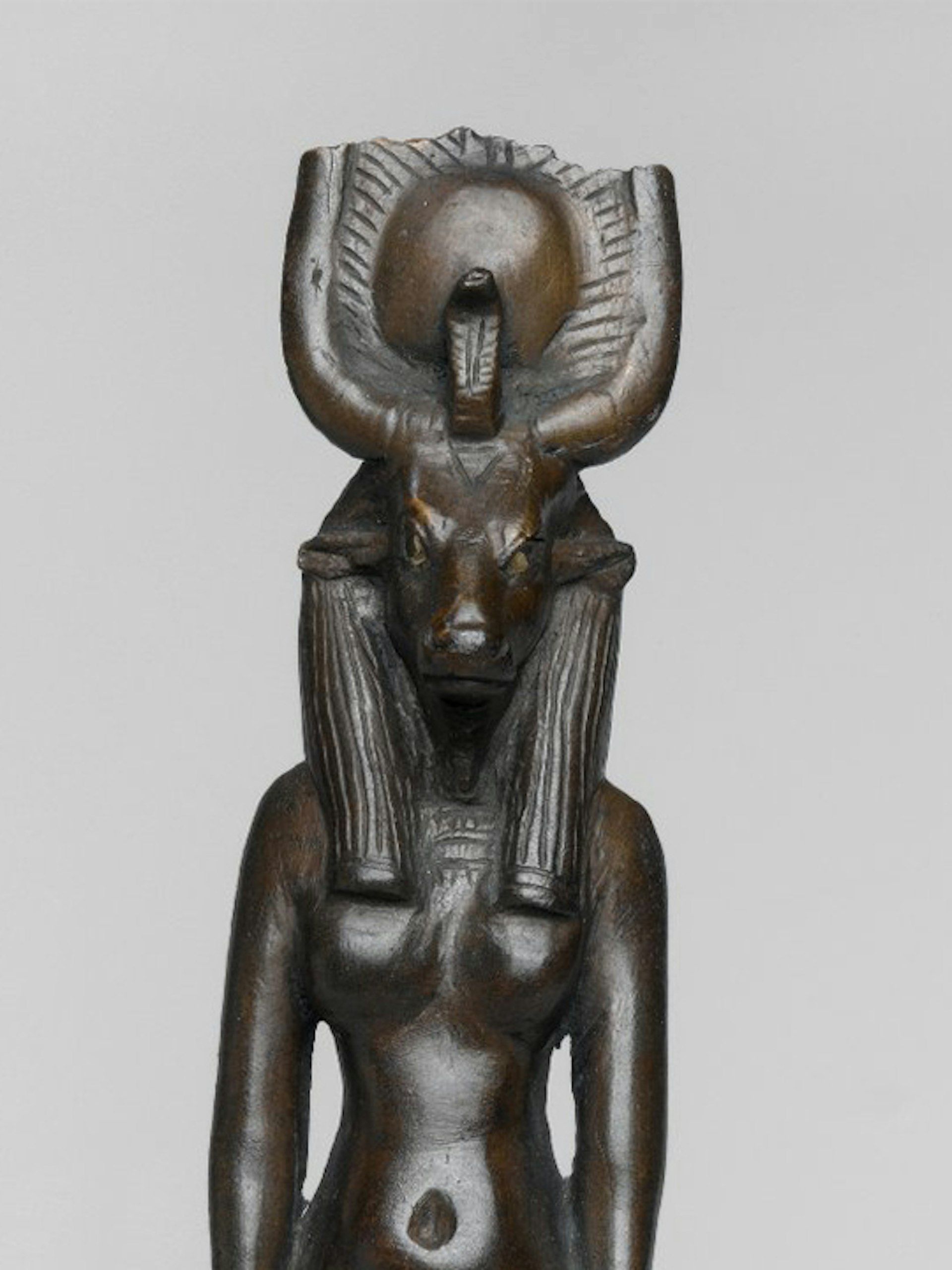
Hathor was the ancient Egyptian deity of many realms: mother to Horus, god of the sky, and Ra, the sun god; and goddess of beauty (including cosmetics), sensuality, music, dancing, and maternity. She is often depicted wearing a headdress of cow horns with a sun disk between them, or as a cow or lioness. Worshiped across ancient Egypt and Nubia, from royal temples to domestic family altars, Hathor was one of the most important divinities in the ancient Egyptian and Nubian pantheons.
“The
worship of Hathor spread from Egypt to Nubia,” says Solange Ashby, a
scholar of ancient Egyptian language and Nubian religion. “The oldest
evidence of worship can be found in Egypt in the Old Kingdom, or the
earliest period (around 2300 BCE).” Hathor
is one of the pre-dynastic deities of the Ancient Egyptian pantheon.
She is important to us because she was the goddess of the arts. (1)


Hathor
Hathor played various roles such as: the goddess of heaven, wife of the celestial god Horus and the solar god Ra. Hathor was the mythological mother of their earthly regents, pharaohs.
The name Hathor, translates as “The House of Horus”, for her role as a mother and in many cases wife of Horus, which identified her as the queen of Egypt, with her name Hathor.
Her name can be seen as a hawk inside a square representing the house, and that means a divine mother who revives all the obvious.
2
Goddess of the Arts
Hathor represented the musical arts and dance, reason why the arts were kept under her domain. The first known priestess of Hathor was Neferhtepes, (pharaoh of the mid Thirteenth Dynasty ruling in the second half of the 18th century BC during the late Middle Kindom) daughter of King Radjedef, during the old kingdom.

Neferhtepes
Hathorian priestesses were part of the court circle. Given Hathor's strong links to music and dance, one may assume that all priestesses of the goddess played musical instruments and dance.
Graves-Brown (2010) describes Old Kingdom depictions of women dancing, shaking sistra and offering menit-necklaces for Hathor, such as in the tomb of Senebei at Meir.
Hathor’s cult was unusual, as both men and women were her priests (most Egyptian deities had clerics of the same gender as they). Those priests were also dancers, singers, and other entertainers.

Banquet scene from the tomb chapel ofNebamun, 14th century BC.
Its imagery of music and dancing alludes to Hathor.
During the Old Kingdom a large number of high-class women were priestesses of Hathor, with the priestly rank of hemet netjer. Hemet netjer was the feminine form of a common male priest title called hem netjer, which donated a type of priest within the temple hierarchy. This title seems to be in use until the Middle Kingdom.
There were also women who ‘performed wab service for Hathor’ during the Old Kingdom and received the same payment as male wab priests. The title used was wabet, which is from wab meaning ‘to be pure.’
Many of them were dancers, actors, singers, artisans, musicians, and acrobats who turned their talents into creating rituals that were nothing short of works of art.
Music and dance were part of the worship of Hathor like no other deity in Egypt. Belly dancing was considered especially sacred to Hathor. … Hathor’s priestesses wore patterned red dresses, long red scarves, and beaded menat necklaces. The priestesses of Hathor were also oracles and midwives.
Also, a special kind or variant of the funeral dance dating to the Middle and New Kingdom was performed in honor of Hathor. It was characterized by leaping or skipping and was meant to celebrate the coming of that goddess.
Hathor could represent the comely aspect of the dangerous Sekhmet, but she was also the goddess who met the dead at the entrance of the underworld.
She was responsible for helping the deceased enter the underworld and was the main agent of their rebirth, so an appeal to her was recited or sung, accompanied by the clapping of hands and sticks and the use of other percussion instruments.
Question 1
What is the importance of Hathor from a dance history point of view?
3

Sistrum
Menit-Necklance

The menit is a ceremonial object associated with the goddess Hathor whose priestesses are commonly shown holding the emblem. Queens and ladies of waiting, when officiating as priestesses also wore or carried it. Like the sistrum, this elaborate necklace may have actually functioned as a kind of percussion instrument in certain religious contests.
As an important attribute of Hathor, the menit seems to have functioned as a medium through which the goddess' power was transmitted, and many representations show her proffering the menit to the king. She performs this act in two ways. At times, she may wear the menit, lifting up the front section toward the king. Otherwise, she simply holds the object in her hands while offering it to the king.
Question 2
Why would the menit be an important object to characterize Hathor in an Ancient Egypt scene?
4
Festival of Hathor
During the festival of Hathor, the priestesses of the goddess would go from door to door shaking menits and sistras to endow the occupants of each house with the favors of life, health, and rebirth.
According to Graves-Brown (2010), in the Old Kingdom most priests of Hathor were female, but it was men who were overseers of these priests. While women were overseers of dancers and singers, men were overseers of professional musicians who were nearly always men.
Question 3
IV
A Note to Remember
The power of a myth for humans is that it lets them know what the patterns of life have been throughout the centuries and their role within them.
V
Case Study
1
Art of Ancient Egypt Through Dance
Hathor was the ancient Egyptian deity of many realms: mother to Horus, god of the sky, and Ra, the sun god. Horus, Egyptian Hor, Har, Her, or Heru, in ancient Egyptian religion, a god in the form of a falcon whose right eye was the sun or morning star, representing power and quintessence, and whose left eye was the moon or evening star, representing healing.(2)
Production Consultant: Glorianna Davenport
G. Davenport is a New York-born media maker. In 1979, Davenport, working with cinematographer Richard Leacock, filmed Art of Ancient Egypt Through Dance. (3)
Glorianna Davenport is a New York-born media maker. A co-founder of the MIT Media Lab. Davenport directed the Interactive Cinema research group from 1987–2004 and the Media Fabrics research group from 2004-2008. Davenport retired from the Massachusetts Institute of Technology in the Summer of 2008. From 2008 to the present, she has managed the transition of Tidmarsh Farms, a former 610 acre cranberry farm in Plymouth Massachusetts, into conservation and wetland restoration. In 2011, Davenport founded Living Observatory, a non-profit, learning collaborative that focuses on documenting and sharing the long term story of wetland restoration of former cranberry farms. In this work, Davenport returned as a visiting scientist at the MIT Media Lab where she works closely with the Responsive Environments Group
Innovative documentary filmmaker Richard Leacock, helped create the cinéma vérité style and was a driving force behind the film program at MIT. Leacock was best known for expanding the possibilities of documentary film through the use of small, mobile, hand-held cameras, which provided documentaries with greater immediacy and opened up the range of subjects and scenes that could be filmed. He also helped devise some of the technical innovations necessary to provide high-quality sound for hand-held cameras.
Questions 4 & 5
If you were to guess, who would you say these characters represent in the myth?
What part of the myth are they representing?
VI
Activity
Students will create groups. Each group will work on enacting one myth related to Hathor.
Groups
1 The Primeval Hand
Georgia B., Natalie, VW, Tatiana M.
The Egyptian creation myth centered around a creator god (usually Ra, but possibly Ptah, Atum, or Amun, depending on the tale) who brought the world into being by ejaculating and created the first gods through his seed.
Hathor’s cult held that the goddess was both the hand that aroused the creator and the vital force of his seed. The Coffin Text alluded to her role in the formation of the universe, declaring her “the Primeval, the Lady of All.”
Because Ra created his Eye (one of Hathor’s manifestations), and Hathor helped him create the world in turn, Hathor was said to be her own mother.
2 Beer Quenches Hathor's Thirsty for Blood
Sophia T., Tori H., Lana F. Ashna V.
Some myths in Egyptian mythology were recurring—as was the case with the pacification of powerful female deities.
This myth began with humanity making fun of Ra in his old age. Ever sensitive to insults, Ra sent his daughter Hathor to punish humans for their insolence. In the form of a lioness, she slaughtered all who dared to ridicule Ra.
Ra eventually decided that the humans had been punished enough and called Hathor off. By this time, however, she had become enamored with her slaughter and refused to stop. For all his might, Ra could do nothing to stop her.
In order to halt her rampage, Ra ordered that 7000 barrels of beer to be made and mixed with the crimson fruit of the mandrake. The spiked beer was then sent out across the countryside in a single night.
When Hathor next sought to slake her bloodlust, she found the barrels of blood-red beer waiting for her. Hathor was intrigued, and stopped to try the strange concoction. Finding it delicious, kept drinking until she fell into a deep slumber.
The mandrake juice did changed more than the beer’s color! It enhanced the drink’s sedative properties as well.
By the time she awoke, her wrath had passed and Ra was able to convince her to return home.This myth may have served as justification for the bountiful consumption of alcohol during the annual Feast of Hathor.
3 Hathor's Dirty Dancing
Erin H., Alie L., Ana C. , Lana A., Boxiang S.
One notable myth involving Hathor was quite peculiar, and not fully understood.
A particularly heated debate occurred during the trial of Horus and Set - an event that would determine Egypt’s rightful ruler once and for all. In the midst of this debate, the god Babi insulted Ra by telling him “your shrine is empty.” This quip caused the sensitive Ra to storm out of the trial, leaving the proceedings without a judge.
4 Restoring Horus' Sight
Shamus, Grave R., Franchesca R.,Ananya M., Caro M.
Hathor assisted Horus on other occasions as well. Following a particularly brutal battle with Set, Horus found himself utterly defenseless. Seizing his opportunity, merciless Set beat the broken Horus before plucking out his eyes and burying them in ground.
Horus was left helpless and alone on a mountainside until Hathor found him crying in pain. Taking pity on the poor god, Hathor caught a wild gazelle and poured its milk into Horus’s vacant sockets, miraculously restoring his sight.
5 Gehesty and the Origin of Juniper
Alyssa A., Drake, Ashley T., Anna S.
Ancient Egypt was divided into regions called nomes, with each region having a god or pair of gods associated with it. Some of these regions were hotspots for mythological activity, with geography and a bit of luck conspiring to create areas with considerable religious significance. Hathor had an intimate connection to the region of Gehesty. During Set’s reign, she lurked on a mountain in the north and preyed upon his followers. As a great serpent, she killed any Set supporter that dared to approach the mountain. When their blood fell upon the ground, the droplets turned into juniper berries.Legend holds that Hathor—as well as Shu, Osiris, and Horus—were all buried in Gehesty.
6 Catering the After Life
Max H., Maffie O., Gaby S.
Hathor initially played a minor role in the Egyptian afterlife by overseeing the trials of deceased souls. Over time, however, her role expanded to providing nourishment to the dead. Sitting beneath her sacred sycamore, she served food and milk from her seven cows (also known as the Seven Hathors).
The Seven Hathors played their own role in the afterlife, determining a person’s lifespan and the cause of their death.
Just because the dead could expect Hathor to provide food did not mean they were free to live off the work of others. In Spell 189 from the Book of the Dead, the deceased was asked by the demon One who Cannot Count if they “will…live on someone else’s goods everyday.[sic]”
In this painting of a tomb relief (circa 1295–1170 BCE), a Hathor cow is nearby as the deceased (left) is eating and drinking with a deified king Mentuhotep and queen Ahmose-Nefertari.
The deceased’s reply was that, while they intend on dining under the Hathor’s sycamore, they also intended on ploughing the Field of Reeds.Even in death, the Egyptians did not appreciate freeloaders.
7 The Festival of the Sacred Marriage
Sarah Z., Jeeny R., Marcus P.
The Festival of the Sacred Marriage was a ritual dating to the Ptolemaic period. In this ceremony, which began 18 days into the month of Paoni, Hathor and Horus of Edfu were husband and wife. Hathor’s idol was taken from her temple at Dendera upriver to Horus’s temple at Edfu.
When Hathor arrived at the temple, Horus’s image was brought down to the river to greet her. The following day (the anniversary of Horus’s victory over Set), the pair left Horus’s temple to continue traveling upriver. Along their journey, the pair celebrated rituals such as the Opening of the Mouth and the Festival of Behdet.
Hathor Temple is the dominant building at the Dendera Temple complex.
The festivities continued until Horus and Hathor had celebrated their marriage with a night of drinking and revelry open to all. When the festival ended, the couple’s idols were returned to their respective temples until the following year.
VI
Journaling
VII
Glossary
(3) Pioneering filmmaker Richard Leacock, former MIT professor, dies at age 89. https://news.mit.edu/2011/leacock-obit-0325
http://www.livingobservatory.org/
https://tidmarsh.media.mit.edu/


Comments
Post a Comment